
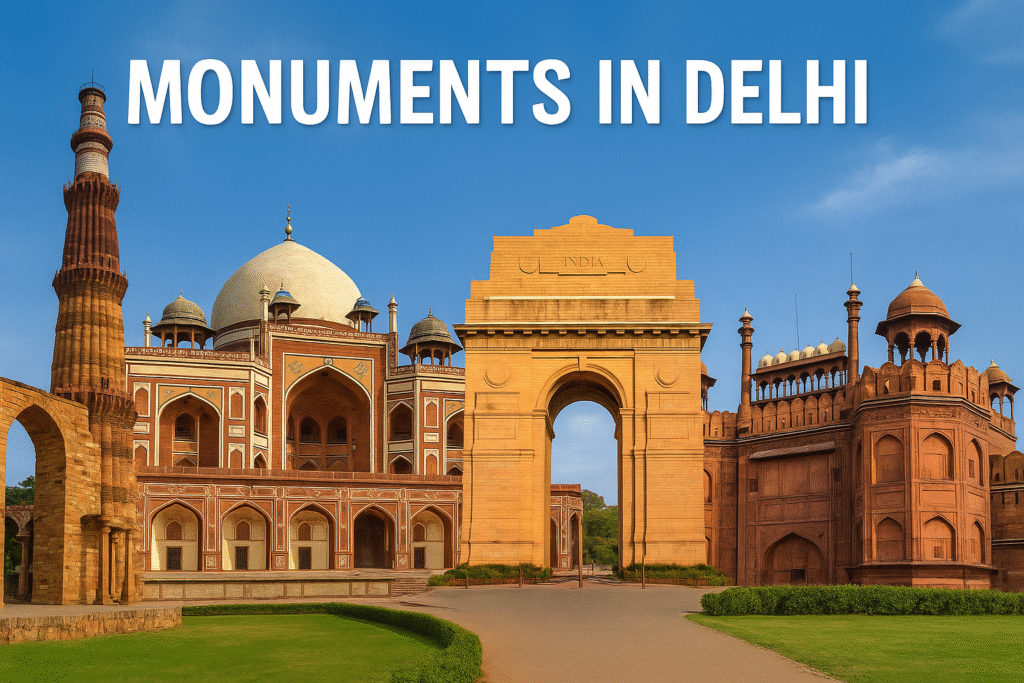
Delhi, India’s capital, is not just a bustling metropolis — it is a living archive of human civilization. The monuments in Delhi stand as architectural marvels that symbolize India’s rich past and cultural diversity. From ancient Hindu temples and Mughal forts to colonial memorials and modern icons, these structures reflect the evolution of art, faith, and power.
Every street, pillar, and dome in this city whispers stories of empires that once flourished here. With a history stretching back over 3,000 years, Delhi has been home to the Pandavas of Indraprastha, the Mughals of Shahjahanabad, and the British of New Delhi.
The Timeless Significance of Delhi’s Monuments
Delhi’s monuments are more than architectural wonders; they are symbols of India’s composite culture — a confluence of Hindu, Islamic, Sikh, and British influences. The city houses three UNESCO World Heritage Sites:
- Red Fort Complex
- Qutub Minar and its Monuments
- Humayun’s Tomb
Each monument represents a distinct era — the Sultanate, the Mughal Empire, and the colonial period — collectively narrating India’s transformation into a modern democracy.
International tourists love visiting these sites not just for their beauty but for their cultural depth, photographic appeal, and spiritual aura that make Delhi a must-see destination on the global map.
1. The Red Fort (Lal Qila)
Historical Background
The Red Fort, constructed by the great Mughal Emperor Shah Jahan between 1638 and 1648, stands as one of the most celebrated and majestic monuments in Delhi. Situated in the bustling heart of Old Delhi, this grand fort was not only a royal residence but also the epicenter of Mughal power, administration, and culture for nearly two centuries, until 1857, when the last Mughal emperor, Bahadur Shah Zafar, was dethroned by the British.
Built primarily from red sandstone, the fort’s massive walls stretch over 2.5 kilometers, enclosing an extraordinary complex of palaces, audience halls, gardens, and pavilions. Its architecture marks the zenith of Mughal creativity and craftsmanship, blending the refined aesthetics of Persian, Timurid, and Indian design traditions into a seamless whole. The fort’s construction symbolized the emperor’s vision of establishing Shahjahanabad (present-day Old Delhi) as the new capital of his empire — a city of unmatched beauty and grandeur.
The Red Fort was meticulously planned with a perfect balance of symmetry, geometry, and proportion. Its Lahori Gate, the main entrance, opens into a vibrant bazaar called the Chatta Chowk, once filled with traders selling fine silk, jewelry, and handicrafts to the Mughal elite. Beyond the market lies the Naubat Khana, or Drum House, where royal musicians announced the emperor’s arrival.
Inside, the fort features several breathtaking structures that showcase the pinnacle of Mughal architecture. The Diwan-i-Aam (Hall of Public Audience) was where the emperor met his subjects and listened to their petitions. The Diwan-i-Khas (Hall of Private Audience), adorned with marble, inlay work, and delicate carvings, housed the legendary Peacock Throne, inlaid with precious jewels and gold. In this chamber, Shah Jahan and his successors held private meetings with ministers and foreign envoys.
Key Structures Inside
- Lahori Gate – the main entrance, still used for Independence Day celebrations.
- Diwan-i-Aam – the Hall of Public Audience, where Shah Jahan addressed citizens.
- Diwan-i-Khas – a marble chamber that once housed the legendary Peacock Throne.
- Rang Mahal – the “Palace of Colors,” adorned with intricate mirror work.
- Hammam – royal baths with marble floors and flowing water channels.
Global Importance
The Red Fort was declared a UNESCO World Heritage Site in 2007. It is globally recognized as a masterpiece of Mughal engineering and a symbol of India’s sovereignty — as the Indian Prime Minister hoists the national flag here every 15th August.
Why Tourists Love It
Tourists admire the Red Fort for its grand scale, artistic detailing, and historic aura. The light-and-sound show held every evening vividly recreates Delhi’s history, making it a favorite among international visitors.
How to Reach from Airport
From Indira Gandhi International Airport (IGI):
- By Metro: Take the Airport Express Line to New Delhi Metro Station, then switch to the Yellow Line towards Chandni Chowk. Red Fort is a short rickshaw ride from there.
- By Taxi: Approx. 40 minutes (20–25 km).
- By Bus: DTC buses and airport shuttles operate via Connaught Place and Daryaganj.
2. Qutub Minar and Its Monuments
Historical Background
Located in the historic district of Mehrauli, the Qutub Minar complex is one of the earliest and most magnificent monuments in Delhi that marks the advent of Islamic rule in India. This towering minaret, rising gracefully to a height of 73 meters, stands as a proud symbol of victory, faith, and architectural brilliance that has withstood the passage of more than eight centuries.
The foundation of the Qutub Minar was laid by Qutb-ud-din Aibak in 1192 CE, shortly after he established the Delhi Sultanate. He was the founder of the Mamluk (Slave) dynasty and a trusted general of Muhammad Ghori, whose victory in the Second Battle of Taraori (1192 CE) opened the way for Muslim rule in northern India. Although Aibak began the construction of this magnificent tower, he completed only the first storey during his lifetime. His successor and son-in-law, Shams-ud-din Iltutmish, added three more storeys, and later Firoz Shah Tughlaq repaired and extended the structure after it was damaged by lightning in the fourteenth century.
The Qutub Minar was conceived not only as a victory tower but also as a minaret attached to the Quwwat-ul-Islam Mosque, the first mosque built in India. From its balconies, the muezzin would call the faithful to prayer, symbolizing the establishment of a new cultural and religious order. The minaret’s tapering cylindrical form, built in red and buff sandstone, exhibits intricate carvings of Qur’anic inscriptions, floral motifs, and geometric designs — hallmarks of early Indo-Islamic art. The lower three storeys are made of red sandstone, while the upper sections incorporate marble, revealing the evolution of construction techniques over successive dynasties.
Architectural Significance
- Built of red and buff sandstone, the Qutub Minar has five distinct storeys, each with carved balconies and inscriptions from the Qur’an.
- The surrounding complex includes the Quwwat-ul-Islam Mosque (India’s first mosque) and the Iron Pillar, famous for its rust-resistant metallurgy dating back to the Gupta period.
Global Importance
Recognized by UNESCO in 1993, Qutub Minar represents the beginning of Indo-Islamic architecture in India. The use of local craftsmanship with Persian calligraphy created a new artistic language that influenced later Mughal design.
Why Tourists Love It
Visitors are fascinated by its sheer height, precision, and the mystery of the Iron Pillar, which has not rusted for over 1,600 years. The serene gardens and evening illumination make it a photographer’s paradise.
How to Reach from Airport
From IGI Airport:
- By Metro: Airport Express to New Delhi Station, then Yellow Line to Qutub Minar Station.
- By Taxi: Around 35 minutes (13–15 km).
- By Bus: Route via Mahipalpur–Mehrauli.
3. Humayun’s Tomb
Historical Background
Among the most graceful and historically significant monuments in Delhi, Humayun’s Tomb stands as a shining symbol of the Mughal Empire’s artistic vision, architectural innovation, and deep cultural fusion. Commissioned in 1565 CE by Empress Haji Begum, the devoted wife and chief consort of Emperor Humayun, the tomb represents the first mature expression of Mughal architecture in India. Designed by the eminent Persian architect Mirak Mirza Ghiyas and his son Sayyid Muhammad, this masterpiece set the tone for centuries of Indo-Islamic architectural excellence and served as the direct inspiration for the Taj Mahal built nearly a century later.
The construction of Humayun’s Tomb began nine years after the emperor’s death and was completed around 1572 CE during the reign of Emperor Akbar, Humayun’s son. Empress Haji Begum personally oversaw the project, ensuring that it reflected both the grandeur of the Mughal dynasty and the spiritual serenity befitting a royal resting place. The tomb is set within a vast 30-acre Charbagh (four-part Persian garden) divided by symmetrical water channels that represent the four rivers of paradise mentioned in the Qur’an — symbolizing the Mughal belief in eternal peace and divine order.
Architectural Features
Built in red sandstone and white marble, the monument stands in the center of a charbagh — a four-part Persian garden symbolizing paradise. The tomb contains not only Emperor Humayun’s grave but also those of several Mughal royals.
Global Importance
In 1993, Humayun’s Tomb was designated as a UNESCO World Heritage Site for introducing Mughal architectural style that later matured under Akbar and Shah Jahan.
Why Tourists Love It
The perfect symmetry, peaceful gardens, and historical value make it one of the most-visited monuments in Delhi. Tourists often describe it as “a silent prelude to the Taj Mahal.”
How to Reach from Airport
- By Metro: Airport Express to New Delhi Station, then Violet Line to JLN Stadium or Jangpura Station.
- By Taxi: About 40 minutes (18 km).
- By Bus: DTC buses via Lodi Road or Nizamuddin.
4. India Gate
Historical Background
Among the most iconic and emotionally powerful monuments in Delhi, the India Gate stands as a timeless tribute to valor, patriotism, and sacrifice. Built in 1931, this monumental sandstone arch was designed by the renowned British architect Sir Edwin Lutyens, who also planned much of New Delhi. India Gate was conceived as a war memorial to honor the memory of more than 84,000 Indian soldiers who laid down their lives fighting for the British Indian Army during World War I (1914–1918) and the Third Anglo-Afghan War (1919).
Rising 42 meters above the ground, India Gate dominates the ceremonial boulevard of Rajpath (now renamed Kartavya Path), stretching from Rashtrapati Bhavan (the President’s House) to the National Stadium. It occupies the very heart of the capital and serves as the centerpiece of the grand imperial city envisioned by Lutyens and Herbert Baker, who together transformed Delhi into the seat of the British Empire in India.
Constructed primarily from Bharatpur red and yellow sandstone, India Gate exudes a sense of classical dignity and solemnity. The design of the memorial was inspired by the Arc de Triomphe in Paris, but with distinctive Indian elements that give it its unique identity. The names of more than 13,000 soldiers are inscribed on its walls, etched into the stone for eternity.
Architectural Features
- Made of Bharatpur sandstone.
- The Amar Jawan Jyoti (Flame of the Immortal Soldier) was added in 1971 to honor martyrs of the Indo-Pak war.
- Surrounded by lush lawns, fountains, and the Rashtrapati Bhavan vista.
Why Tourists Love It
India Gate is not just a war memorial; it’s a symbol of national pride. Tourists love its grandeur, evening illumination, and patriotic atmosphere. The surrounding lawns are perfect for leisure walks and family picnics.
How to Reach from Airport
- By Metro: Airport Express to New Delhi, then Yellow Line to Central Secretariat Station.
- By Taxi: 30 minutes (15 km).
- By Bus: Regular DTC services via Connaught Place.
5. Jama Masjid
Historical Background
Constructed between 1644 and 1656 by Emperor Shah Jahan, the Jama Masjid is India’s largest mosque and one of the finest examples of Mughal religious architecture. It was originally called Masjid-i-Jahan-Numa, meaning “mosque commanding the view of the world.”
Architectural Features
- Built in red sandstone and marble, with three domes and two 40-meter-high minarets.
- The courtyard can accommodate 25,000 worshippers.
- The mosque houses relics of Prophet Muhammad, including a hair and a pair of his sandals.
Why Tourists Love It
Jama Masjid’s scale, artistry, and spiritual serenity captivate visitors. The panoramic view from its southern minaret offers a breathtaking look over Old Delhi.
How to Reach from Airport
- By Metro: Airport Express to New Delhi, then Yellow Line to Chandni Chowk Station; walk or rickshaw to the mosque.
- By Taxi: Around 45 minutes (22 km).
- By Bus: DTC routes via Daryaganj or Kashmere Gate.
6. Purana Qila (Old Fort)
Historical Background
Believed to stand on the ancient site of Indraprastha, Purana Qila was rebuilt by Sher Shah Suri (1540–1545). Archaeological excavations suggest habitation dating back to the Mauryan period.
Architectural Highlights
- Massive ramparts with three gateways: Humayun Gate, Bara Darwaza, and Talaqi Darwaza.
- Inside lie Sher Mandal, a double-storey octagonal tower used by Humayun as a library.
- The fort’s moat and lush lawns add to its charm.
Why Tourists Love It
Visitors are drawn to Purana Qila’s serenity and connection to the Mahabharata era. The evening light show and boating in the moat make it a perfect heritage leisure spot.
How to Reach from Airport
- By Metro: Airport Express to New Delhi Station, then Violet Line to Pragati Maidan.
- By Taxi: 35–40 minutes (18 km).
7. Lotus Temple
Background
Dedicated to the Baháʼí Faith, the Lotus Temple was completed in 1986. Shaped like a blooming lotus flower, it symbolizes purity, peace, and unity of all religions.
Architectural Features
- Designed by Iranian architect Fariborz Sahba.
- Constructed using white marble from the Penteli mountains of Greece.
- Comprises 27 petals arranged in clusters of nine.
- No idols or rituals — open to people of all faiths.
Why Tourists Love It
The temple’s futuristic design and tranquil atmosphere attract spiritual seekers and architecture lovers worldwide. It’s one of Delhi’s most photographed landmarks.
How to Reach from Airport
- By Metro: Airport Express to New Delhi Station, then Violet Line to Kalkaji Mandir.
- By Taxi: 40 minutes (20 km).
8. Akshardham Temple
Background
Opened in 2005, the Swaminarayan Akshardham Temple showcases traditional Indian architecture combined with modern design. Built entirely from pink sandstone and white marble, it celebrates India’s spiritual heritage.
Architectural Highlights
- The central monument features a 43-meter-high dome and over 20,000 statues.
- Intricately carved pillars and elephants represent Indian values and nature’s harmony.
- The Yagnapurush Kund (largest stepwell) and water show draw thousands of visitors daily.
Why Tourists Love It
International visitors admire Akshardham for its grandeur, cleanliness, cultural exhibitions, and musical fountain show. It offers a spiritual and cultural experience in one place.
How to Reach from Airport
- By Metro: Airport Express to New Delhi Station, then Blue Line to Akshardham Station.
- By Taxi: 45 minutes (22 km).
9. Safdarjung’s Tomb
Background
Built in 1754 for Nawab Safdarjung, this tomb marks the end of Mughal architectural style. It represents a transitional phase between Mughal and colonial aesthetics.
Features
- Constructed in red sandstone and marble.
- Enclosed within a charbagh garden with fountains and pathways.
- Notable for its large dome, arched facades, and ornate gateways.
Why Tourists Love It
Often called the “last flicker of Mughal glory,” Safdarjung’s Tomb offers peace, symmetry, and fewer crowds — ideal for history enthusiasts and photographers.
How to Reach from Airport
- By Metro: Airport Express to New Delhi Station, then Yellow Line to Jor Bagh.
- By Taxi: 30 minutes (15 km).
10. Tughlaqabad Fort
Background
Constructed by Ghiyas-ud-din Tughlaq in 1321, Tughlaqabad Fort stands as a reminder of Delhi’s medieval power. Though in ruins today, it once had 13 gates, massive stone walls, and a royal citadel.
Why Tourists Love It
Its rugged charm, panoramic views, and archaeological intrigue appeal to explorers seeking Delhi’s lesser-known treasures.
How to Reach from Airport
- By Metro: Airport Express → New Delhi → Violet Line to Tughlaqabad Station.
- By Taxi: 50 minutes (25 km).
🌍 Why International Tourists Love Delhi’s Monuments
- Architectural Diversity – From Islamic domes to colonial arches, Delhi represents global architectural evolution.
- Cultural Immersion – Tourists experience the essence of India through art, faith, cuisine, and festivals around these monuments.
- Accessibility – Excellent transport, multilingual guides, and digital ticketing simplify travel.
- Photographic Value – Each monument offers breathtaking backdrops for photography and film.
- Spiritual and Historical Depth – Visitors feel connected to India’s centuries-old philosophy of unity in diversity.
✈️ How to Travel Comfortably from Delhi Airport
| Transport Mode | Approx. Time | Average Cost | Key Route |
| Metro (Airport Express) | 20–40 min | ₹60–₹100 | Airport → New Delhi → Yellow/Violet Line for major monuments |
| Taxi/Cab | 30–60 min | ₹500–₹900 | Direct routes via NH-48 or Ring Road |
| Bus (DTC/Airport Shuttle) | 60–90 min | ₹60–₹150 | Airport → Connaught Place → Old Delhi / South Delhi |
| Auto Rickshaw | Variable | ₹200–₹400 | Short distances around metro stations |
Conclusion: Delhi — The Eternal City of Monuments
Delhi’s monuments are not mere stones and pillars; they are the soul of India. They narrate tales of conquests and compassion, of emperors and artisans, of faith and resilience.
For international tourists, these sites offer a journey through 5,000 years of continuous civilization — from the ruins of Indraprastha to the domes of Mughal Delhi and the avenues of British New Delhi.
Visiting these monuments in Delhi is like reading the grand epic of India carved in stone — a journey that begins in history and ends in timeless wonder.