
Introduction
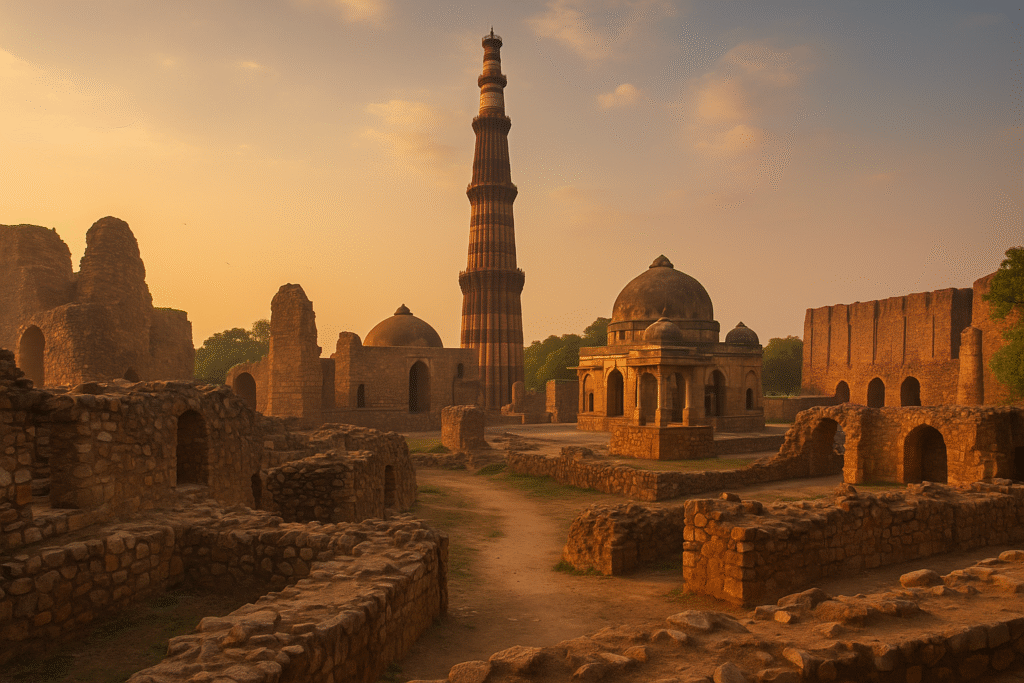
Few cities in the world encapsulate the drama of human civilization as profoundly as Delhi. A city where myth dissolves into history, and ruins breathe alongside skyscrapers, Delhi is not merely a capital — it is a chronicle carved in stone and memory. Every crumbling wall, every surviving dome, and every bustling street echoes a thousand untold stories of ambition, conquest, devotion, and resilience.
When historians speak of the Seven Cities of Delhi, they are not referring to seven isolated sites, but to seven grand experiments in empire-building — each city born from the ruins of its predecessor, each ruler dreaming of permanence in a land shaped by change. From the Rajput stronghold of Lal Kot and the visionary fortifications of Siri and Tughlaqabad, to the imperial splendor of Shahjahanabad, these urban layers trace Delhi’s metamorphosis from a regional citadel to the heart of the Indian subcontinent’s political and cultural imagination.
The phrase “Seven Cities of Delhi” is, in truth, a metaphor for continuity — for Delhi was never destroyed, only reinvented. Each conqueror who entered its plains, whether a Turkic Sultan, Afghan general, or Mughal emperor, found in its dust both inspiration and destiny. They built anew — not merely to assert power, but to inscribe their vision of civilization upon its soil. Thus, Delhi became less a city and more a palimpsest, where the ink of one dynasty was written over the faded letters of another, yet never entirely erased.
This is why Delhi’s geography feels timeless: it is not a single landscape but a layered symphony of centuries. To walk through the Seven Cities of Delhi is to travel through epochs — from medieval ramparts veiled in wild grass to Mughal avenues still alive with color and trade. It is to move between civilizations that spoke in different tongues, worshipped different gods, and envisioned the world through different philosophies, yet all found their home here.
For the international traveler, Delhi offers not just monuments but a conversation with history itself. Within a radius of a few kilometers, one encounters Hindu Rajput forts, Sultanate mosques, Tughlaq bastions, Mughal palaces, and British colonial boulevards, coexisting in dialogue rather than competition. Each structure is a testament to a ruler’s dream — Anangpal’s fort of defense, Alauddin’s city of soldiers, Ghiyasuddin’s fortress of ambition, and Shah Jahan’s walled paradise of refinement.
Yet, beyond power and politics, the Seven Cities of Delhi represent something more enduring — the human need to belong, to build, and to beautify. They stand as the architectural expression of Delhi’s soul, which has endured invasions, plagues, famines, and partitions, but has never ceased to rebuild itself with grace.
Delhi’s urban archaeology thus becomes a profound meditation on time: why do civilizations rise and fall, and what do they leave behind? The answer lies scattered across the city’s plains — in the shadowed arches of Tughlaqabad, the tranquil waters of Hauz Khas, the grandeur of Purana Qila, and the red sandstone glory of Shahjahanabad. These sites are not ruins to be mourned but relics to be read, offering clues to humanity’s eternal pursuit of permanence in a transient world.
The story of the Seven Cities of Delhi is, therefore, the story of mankind itself — our empires, our faith, our artistry, and our longing for immortality. To stand within these cities is to feel the pulse of history beneath one’s feet and the whisper of forgotten centuries in the wind.
And so, as we begin this journey through Delhi’s seven avatars — from Lal Kot’s raw defiance to Shah Jahan’s marble poetry — we uncover not merely the history of a capital, but the spiritual and cultural biography of India itself. For in Delhi, the past does not lie buried — it walks beside us, breathing, luminous, and eternal.
🏙️ 1. Lal Kot / Qila Rai Pithora — The First of the Seven Cities of Delhi (11th–12th Century)
Historical Significance
The first of the Seven Cities of Delhi, Lal Kot was founded in the 11th century by the Tomar Rajputs, particularly Anangpal Tomar II, around 1050 CE. Later, in the 12th century, Prithviraj Chauhan expanded it, creating Qila Rai Pithora — the first fortified urban settlement of what would become Delhi.
It served as the capital of Hindustan before the Muslim conquests, representing the Hindu dynastic power of North India before the arrival of the Mamluks (Slave Dynasty).
Architectural Highlights
- The remnants of massive fortification walls still survive in Mehrauli near the Qutub complex.
- The Iron Pillar, older than Lal Kot itself, stands in the nearby Quwwat-ul-Islam Mosque, a testament to Delhi’s continuity from ancient to medieval periods.
- Early temples, now in ruins, and the Rajaon Ki Baoli (stepwell) in Mehrauli Archaeological Park reflect early urban planning.
Why Tourists Love It
International travelers are drawn to Lal Kot for its authentic archaeological feel — overgrown stone walls, quiet trails, and the sense of walking through India’s first fortified capital. It’s ideal for history lovers, photographers, and scholars tracing Delhi’s ancient past.
How to Reach from IGI Airport
- Metro: Airport Express → New Delhi → Yellow Line → Qutub Minar Station, then short auto ride to Mehrauli.
- Taxi: 30–40 minutes via Mahipalpur–Mehrauli road.
- Bus: DTC routes to Mehrauli Archaeological Park.
🕌 2. Siri — The Second City of Delhi (13th Century)
Historical Significance
Built by Alauddin Khilji (1296–1316), the second of the Seven Cities of Delhi, Siri, was established to house his army and protect against Mongol invasions. It was Delhi’s first completely planned Muslim city and the first to introduce urban defense architecture at scale.
Architectural Highlights
- Siri Fort Wall — massive rubble masonry walls with surviving bastions near present-day Siri Fort Auditorium.
- Hauz Khas Reservoir, built by Alauddin, provided water to Siri and later became the centerpiece of Firoz Shah Tughlaq’s development.
- Siri Fort Sports Complex now stands atop parts of the medieval city’s footprint.
Why Tourists Love It
International visitors enjoy Siri for its blend of ancient ruins and modern life — the juxtaposition of 13th-century bastions against a modern sports arena and South Delhi’s green neighborhoods. It’s an excellent example of how Delhi’s ancient heritage lives beneath its modern rhythm.
How to Reach from IGI Airport
- Metro: Airport Express → New Delhi → Yellow Line → Green Park or Hauz Khas Station; short auto ride.
- Taxi: 25–35 minutes.
🏰 3. Tughlaqabad — The Third City of Delhi (14th Century)
Historical Significance
Founded in 1321 CE by Ghiyasuddin Tughlaq, the formidable founder of the Tughlaq dynasty, the third of the Seven Cities of Delhi, Tughlaqabad stands as a symbol of ambition, power, and tragedy. Designed to be impregnable, it was abandoned shortly after construction due to a curse by the Sufi saint Nizamuddin Auliya.
Architectural Highlights
- The Tughlaqabad Fort — one of the largest fortifications in India, built with sloping granite walls up to 10 meters thick.
- The Mausoleum of Ghiyasuddin Tughlaq, a striking red sandstone and marble tomb connected to the fort by a causeway.
- The nearby Adilabad Fort, built by his successor, complements the complex.
Why Tourists Love It
The romantic desolation of Tughlaqabad fascinates photographers and history enthusiasts. Its stark, geometric design and panoramic hilltop views offer one of the best perspectives of Delhi’s medieval military architecture.
For international visitors, it represents the grandeur and impermanence of empires — a fortress kingdom that rose and fell within a single generation.
How to Reach from IGI Airport
- Metro: Airport Express → New Delhi → Violet Line → Tughlaqabad Station; short auto or taxi ride.
- Taxi: 40–50 minutes via Mehrauli–Badarpur Road.
🌆 4. Jahanpanah — The Fourth City of Delhi (14th Century)
Historical Significance
The visionary Muhammad bin Tughlaq, Ghiyasuddin’s son, founded Jahanpanah (“Refuge of the World”) the fourth of the Seven Cities of Delhi around 1326 CE to unify the earlier settlements of Siri, Tughlaqabad, and Lal Kot. This ambitious urban plan symbolized his attempt to create a vast, centralized city — a metaphor for his dream of uniting a vast empire.
Architectural Highlights
- The Bijay Mandal fort and palace complex — believed to have been the Tughlaq imperial seat.
- Begumpur Mosque — one of Delhi’s oldest surviving congregational mosques, showcasing Tughlaq architectural austerity.
- The ruins of Khirki Mosque, famous for its unique perforated windows (khirkis), are also part of Jahanpanah’s layout.
Why Tourists Love It
International travelers appreciate Jahanpanah’s intellectual aura — this was where one of India’s most eccentric monarchs experimented with urbanism, currency, and theology. The ruins of Begumpur and Khirki exude quiet dignity and are favorite spots for offbeat heritage photography.
How to Reach from IGI Airport
- Metro: Airport Express → New Delhi → Yellow Line → Malviya Nagar; auto/taxi to Begumpur or Khirki.
- Taxi: 30–45 minutes via Aurobindo Marg.
🕋 5. Firozabad — The Fifth City of Delhi (14th Century)
Historical Significance
Built in 1354 CE by Firoz Shah Tughlaq, Firozabad, the fifth of the Seven Cities of Delhi, was established along the Yamuna River, extending Delhi northward. Known for its urban planning, gardens, canals, and learning centers, it reflected Firoz Shah’s administrative genius and cultural foresight.
Architectural Highlights
- The Firoz Shah Kotla Fort — Delhi’s fifth city core, built with rubble masonry. Its palace ruins, underground cells, and bastions still stand tall.
- The Ashokan Pillar, relocated here from Topra in Haryana, showcases Firoz Shah’s fascination with Mauryan heritage.
- The adjacent Jama Masjid of Firoz Shah Kotla is one of Delhi’s oldest surviving mosques.
Why Tourists Love It
Firozabad’s mix of history and mysticism attracts global travelers. On Thursdays, locals light candles here, believing that invisible spirits (djinns) inhabit the ruins — a unique cultural phenomenon that fascinates anthropologists and spiritual tourists alike.
How to Reach from IGI Airport
- Metro: Airport Express → New Delhi → Violet Line → ITO Station, short walk.
- Taxi: 30–40 minutes via Ring Road.
🏯 6. Dinpanah / Shergarh — The Sixth City of Delhi (16th Century)
Historical Significance
The sixth of the Seven Cities of Delhi, Dinpanah, was begun by Mughal Emperor Humayun in 1533 CE on the banks of the Yamuna, reviving Delhi as a seat of empire. Later, Sher Shah Suri captured it, expanded it, and renamed it Shergarh.
This city laid the foundation for Delhi’s reemergence as the Mughal capital.
Architectural Highlights
- The Purana Qila (Old Fort) stands as the heart of Dinpanah-Shergarh. It is one of Delhi’s most visited sites.
- The fort houses the Qila-i-Kuhna Mosque, an exquisite Afghan-style mosque, and Sher Mandal, a double-storeyed octagonal tower where Humayun is said to have died after falling from its steps.
- The nearby National Zoological Park and Delhi Crafts Museum add cultural vibrancy.
Why Tourists Love It
International visitors love Purana Qila for its scale, symmetry, and riverside serenity. Evening light-and-sound shows recreate Delhi’s saga, helping travelers visualize the transformation from the Sultanate to Mughal rule.
The fort’s gardens and reflection pools make it a favorite photography site, especially at sunrise and sunset.
How to Reach from IGI Airport
- Metro: Airport Express → New Delhi → Violet Line → Pragati Maidan Station; 10-minute walk.
- Taxi: 25–35 minutes via Mathura Road.
🏰 7. Shahjahanabad — The Seventh City of Delhi (17th Century)
Historical Significance
The seventh and grandest of the Seven Cities of Delhi, Shahjahanabad, was founded by Emperor Shah Jahan in 1639 CE and completed in 1648. It remains the soul of Old Delhi — a walled city planned with Persian precision and Mughal opulence.
This was the last pre-modern capital before the British built New Delhi, and its heartbeat still echoes in Chandni Chowk and Red Fort.
Architectural Highlights
- Red Fort (Lal Qila) — the imperial palace-fort complex and a UNESCO World Heritage Site. Its Diwan-i-Khas, Diwan-i-Aam, and Moti Masjid are icons of Mughal architecture.
- Jama Masjid, the grand congregational mosque, symbolizing Shah Jahan’s architectural zenith.
- Chandni Chowk, the ceremonial boulevard lined with havelis, markets, and temples.
Why Tourists Love It
International tourists adore Shahjahanabad because it is Delhi in its purest form — sensory, crowded, spiritual, and alive. They explore by rickshaw through bazaars, taste Mughlai cuisine, visit temples and mosques side by side, and watch the Red Fort glow at sunset.
It embodies the living continuity of Indian civilization — a space where emperors once ruled and everyday life still thrives.
How to Reach from IGI Airport
- Metro: Airport Express → New Delhi Station → Yellow Line → Chandni Chowk Station.
- Taxi: 45–60 minutes via Ring Road.
- Bus: Airport coach to CP, then DTC bus to Red Fort.
🌍 Why International Tourists Love the Seven Cities of Delhi
The Seven Cities of Delhi together offer a journey unlike any other — a timeline of civilizations. For international travelers, few cities in the world provide such a condensed yet expansive experience of human history, architecture, religion, and art.
Here’s why they remain globally magnetic:
1. A Journey Through 1,000 Years in One City
From the Tomar Rajputs to the Mughals, Delhi presents India’s historical evolution in seven layers — each city rising on the ruins of the last. It’s a living textbook of world history.
2. Architectural Diversity
Every dynasty brought its style — Rajput walls, Khilji domes, Tughlaq slants, Mughal symmetry — turning Delhi into a museum of architecture under open skies.
3. Spiritual Coexistence
These seven cities fostered temples, mosques, shrines, and churches side by side, symbolizing religious harmony that continues to attract global admiration.
4. Culinary & Cultural Vibrance
From Chandni Chowk’s parathas to Nizamuddin’s qawwalis, each historical city left behind a culinary and cultural legacy that lives on.
5. Accessibility & Tourism Infrastructure
Well-connected metro lines, heritage walks, multilingual guides, and safe public transport make it easy for travelers to explore the Seven Cities of Delhi independently or with curated tours.
🚇 How to Explore the Seven Cities from IGI Airport
Best Starting Point:
Take the Airport Express Line (Orange) to New Delhi Station — the interchange hub connecting all metro lines (Yellow, Violet, Blue).
Suggested Route (Chronological & Efficient):
- Mehrauli (Lal Kot / Qila Rai Pithora) – nearest to Qutub Minar.
- Siri Fort & Hauz Khas (Siri / Jahanpanah) – explore the medieval ruins and reservoir.
- Tughlaqabad Fort – the hilltop fortress of the Tughlaqs.
- Firoz Shah Kotla (Firozabad) – near ITO.
- Purana Qila (Dinpanah/Shergarh) – near Pragati Maidan.
- Red Fort & Jama Masjid (Shahjahanabad) – the final Mughal masterpiece.
Transport Options:
- Metro: Efficient for all sites except Tughlaqabad (requires short auto/taxi).
- Taxi/App Cabs: Ideal for heritage circuits and photography trips.
- Buses & Autos: Affordable for local transit between nearby heritage clusters.
✨ A Civilization in Stone
Delhi is not one city but a constellation of seven civilizations, each built with ambition, faith, and art — and each leaving behind stories that still whisper through its walls. The Seven Cities of Delhi together form one of the greatest continuous urban narratives in human history.
From Anangpal’s fortress to Shah Jahan’s Red Fort, from the chants in Qutub’s mosques to the echoes in Purana Qila, every layer of Delhi is a testament to survival and rebirth. No conqueror ever truly erased Delhi — they only added to its mosaic.
For international visitors, walking through these seven cities is like traveling through centuries in a few kilometers. It’s not just about monuments; it’s about the rhythm of civilization — how people dreamed, ruled, prayed, and built the Seven Cities of Delhi.
Delhi teaches that history is never static — it evolves, breathes, and lives in the laughter of street vendors, the walls of crumbling forts, and the aroma of food drifting from centuries-old kitchens.
The Seven Cities of Delhi stand as proof that no matter how many times the city was destroyed, it rose again — stronger, wiser, and more beautiful. That resilience is the true spirit of Delhi — and the reason why the world keeps coming back to witness its magic.