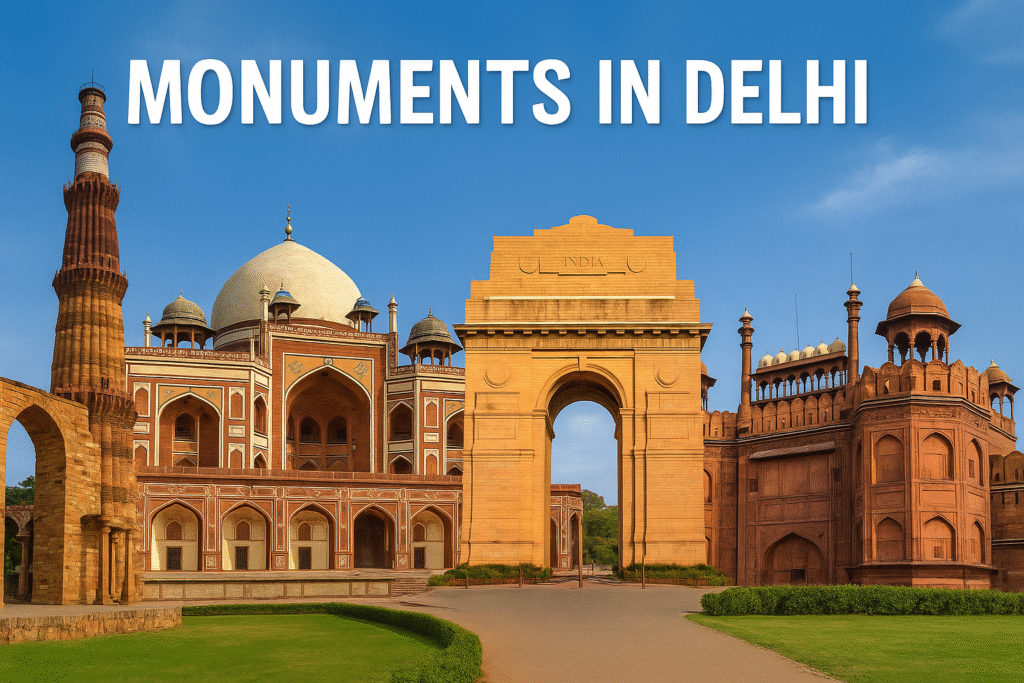
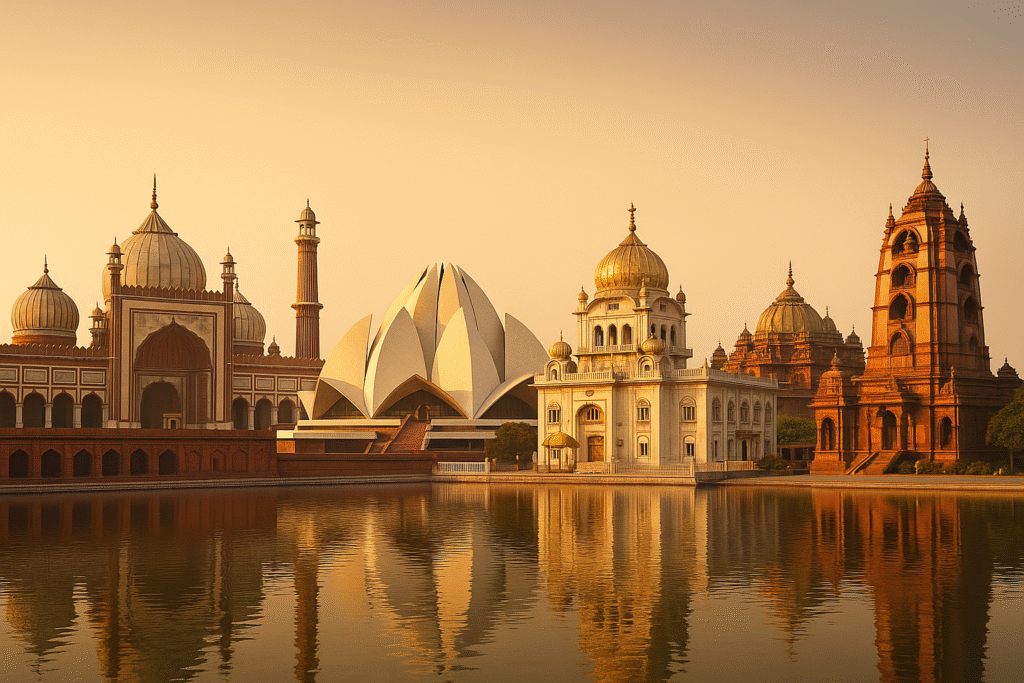
The religious monuments in Delhi are not only sacred spaces but also masterpieces of art, architecture, and coexistence, visited by millions of pilgrims and tourists every year. Delhi, India’s eternal capital, is not just a political and commercial hub — it’s a spiritual crossroads where faiths, philosophies, and architectural marvels meet. The city’s skyline glows with domes, minarets, spires, gurdwaras, temples, and stupas, each narrating centuries of devotion, diversity, and dialogue.
From ancient temples and Mughal mosques to grand cathedrals and modern shrines, these monuments mirror Delhi’s plural identity — a city where spirituality transcends boundaries. International visitors are drawn here not only to worship but to witness how faith shapes culture, community, and beauty.
Let’s embark on a journey through the Top Ten Religious Monuments in Delhi, exploring their stories, architecture, and significance — and how to reach them conveniently from the airport using different modes of transport.
1. Jama Masjid — The Majestic Symbol of Mughal Faith
Historical Significance
Commissioned by Emperor Shah Jahan between 1644 and 1656, the Jama Masjid (Masjid-i-Jahan Numa, “Mosque commanding the view of the world”) is one of the largest and most magnificent mosques in India. Constructed in red sandstone and white marble, it can accommodate nearly 25,000 worshippers in its vast courtyard. The mosque stands at the heart of Old Delhi, overlooking the bustling Chandni Chowk — making it an enduring emblem of Mughal power and piety.
Architectural Beauty
The mosque’s symmetrical design reflects the zenith of Mughal architecture — three majestic domes, two towering minarets (40 meters high), and an expansive courtyard paved with red sandstone. Intricate calligraphy, inlaid marble panels, and a grand central arch showcase the precision and grandeur typical of Shah Jahan’s reign.
Why International Tourists Love It
Tourists love Jama Masjid of Delhi for its sense of timelessness — the call of the muezzin echoing through domes, the view from its minaret revealing Old Delhi’s living tapestry, and its tranquil symmetry amidst urban chaos. It’s a must-visit for history enthusiasts, photographers, and travelers seeking authentic heritage encounters among religious monuments in Delhi.
How to Reach from IGI Airport
- Metro: Airport Express → New Delhi → Yellow Line → Chandni Chowk Station; a short e-rickshaw ride to the mosque.
- Taxi/App Cab: 45–60 minutes depending on traffic.
- Bus: Airport coach to Connaught Place, then local DTC bus to Jama Masjid stop.
2. Akshardham Temple — The Modern Marvel of Spiritual India
Overview
Inaugurated in 2005, the Swaminarayan Akshardham Temple represents the spirit of modern India’s devotion and craftsmanship. Built under the BAPS Swaminarayan Sanstha, this grand complex celebrates Indian art, spirituality, and culture through architecture, exhibitions, and gardens.
Architecture and Features
Constructed from pink sandstone and white marble — without steel — Akshardham rises 43 meters high with 234 intricately carved pillars, 9 domes, and 20,000 statues depicting saints and deities. Its Yagnapurush Kund is the largest stepwell in the world, and the musical fountain show symbolizes the cycle of life.
Why International Tourists Love It
Akshardham offers visitors a journey through time — from ancient wisdom to modern creativity. The sound-and-light shows, spiritual boat rides, and massive scale leave a profound impression. Among all religious monuments in Delhi, it best showcases India’s continuity between faith, philosophy, and design.
How to Reach from IGI Airport
- Metro: Airport Express → New Delhi → Blue Line → Akshardham Station.
- Taxi: 45 minutes depending on traffic.
- Bus: Airport to Rajghat, then DTC bus to Akshardham.
3. Lotus Temple — The Universal House of Worship
Overview
The Lotus Temple, dedicated to the Baháʼí Faith, opened in 1986 and symbolizes unity, peace, and equality. Shaped like a lotus flower, it welcomes people of all faiths to meditate and reflect. Built by Iranian architect Fariborz Sahba, it’s one of the most visited buildings in the world.
Architecture
The temple’s design includes 27 white marble petals arranged in clusters of three to form nine sides. The hall seats 2,500 people, with no idols, rituals, or sermons — reflecting the Baháʼí principle of universal faith. The structure uses natural light, air, and silence to inspire meditation.
Why International Tourists Love It
Visitors from across the globe love the temple’s minimalist elegance and message of inclusivity. The atmosphere of quiet introspection — amidst the chaos of a metropolis — makes it a spiritual sanctuary. It’s one of the most photographed religious monuments in Delhi, symbolizing harmony across humanity.
How to Reach from IGI Airport
- Metro: Airport Express → New Delhi → Violet Line → Kalkaji Mandir Station (short walk).
- Taxi: 35–45 minutes.
- Bus: DTC buses connect Kalkaji to major city points.
4. Gurudwara Bangla Sahib — The Sacred Sikh Shrine of Serenity
Historical Background
Among the most revered religious monuments in Delhi, Gurudwara Bangla Sahib is a center of Sikh faith and service. Originally the bungalow of Raja Jai Singh in the 17th century, it became sacred after Guru Har Krishan Sahib Ji, the eighth Sikh Guru, stayed here during a cholera epidemic in 1664 and selflessly served the sick.
Features
The white marble domes, gold-plated central dome, and the Sarovar (holy pond) create an atmosphere of purity. The Langar hall serves free meals to thousands daily, embodying Sikhism’s principle of equality and community service.
Why International Tourists Love It
Visitors are moved by the spirit of sewa (service) and humility. Many volunteer in the kitchen, cooking or serving meals regardless of religion or nationality. The devotional kirtan and the reflection of domes in the Sarovar make this Gurudwara an unforgettable experience.
How to Reach from IGI Airport
- Metro: Airport Express → Shivaji Stadium Station (10-minute walk).
- Taxi: 25–35 minutes via Connaught Place.
- Bus: Airport coach to Connaught Place, then local bus to Gole Dak Khana.
5. Akbar’s Tomb — Secular Spirituality in Stone (Sikandra, Delhi Border Region)
Overview
Though located near Delhi’s broader cultural belt, Akbar’s Tomb is often included among religious monuments in Delhi for its spiritual symbolism and architectural fusion. Built between 1605–1613, this Mughal masterpiece at Sikandra (bordering NCR) is the resting place of Emperor Akbar, who propagated the ideal of “Sulh-i-kul” (universal peace).
Architecture
Constructed in red sandstone with marble inlay, it fuses Persian, Hindu, and Islamic motifs — symbolizing Akbar’s policy of religious tolerance. Its tiered structure, chhatris, and geometric gardens reflect a vision of unity beyond sectarian lines.
Why International Tourists Love It
It represents the idea of interfaith harmony at the core of Indian civilization. Tourists appreciate its spiritual depth — a tomb built for an emperor who tried to reconcile all faiths — and its exquisite artistry.
How to Reach from IGI Airport
- Taxi/App Cab: Approx. 90 minutes (depending on route toward Agra expressway).
- Metro + Cab: Airport Express → New Delhi → Blue Line to Noida, then cab to Sikandra region.
6. ISKCON Temple (Sri Sri Radha Parthasarathi Mandir) — Devotion Through Music and Light
Overview
Located at Hare Krishna Hills near East of Kailash, the ISKCON Temple (built in 1998) is a vibrant center of Gaudiya Vaishnavism, dedicated to Lord Krishna and Radha. The International Society for Krishna Consciousness promotes devotion through music, dance, and service.
Architecture and Experience
Combining modern and traditional styles, the temple houses exquisite idols, murals depicting the Bhagavad Gita, and a museum that uses light-and-sound shows to narrate Krishna’s life. Evenings come alive with devotional chants, aarti, and prasadam distribution.
Why International Tourists Love It
Visitors adore the spiritual energy and artistic presentation. The temple offers a peaceful retreat and authentic cultural immersion — especially for travelers exploring India’s religious philosophy. Among all religious monuments in Delhi, ISKCON uniquely merges worship with multimedia experience.
How to Reach from IGI Airport
- Metro: Airport Express → New Delhi → Violet Line → Nehru Place or Kalkaji Mandir (walk/auto).
- Taxi: 35–45 minutes.
7. Lakshmi Narayan Temple (Birla Mandir) — Faith and Freedom
Background
Built in 1939 by the Birla family and inaugurated by Mahatma Gandhi, the Lakshmi Narayan Temple stands at the foot of central Delhi’s Mandir Marg. Dedicated to Lord Vishnu (Narayan) and Goddess Lakshmi, it was among the first grand Hindu temples accessible to all castes — embodying India’s freedom-era social progress.
Architecture
Constructed in red and white stone, the temple blends Nagara and modern design. The shrines, gardens, fountains, and relief panels depict scenes from Indian mythology. The main sanctum houses idols of Vishnu and Lakshmi adorned with gold and vibrant fabrics.
Why International Tourists Love It
Its historical connection to India’s freedom struggle, accessible location, and panoramic view of central Delhi make it an essential stop. The temple’s inclusive spirit resonates deeply with global visitors exploring religious monuments in Delhi as symbols of both devotion and democracy.
How to Reach from IGI Airport
- Metro: Airport Express → New Delhi → Yellow Line → Ramakrishna Ashram Marg, then 10-minute auto ride.
- Taxi: 30–40 minutes via Connaught Place.
- Bus: Airport coach to CP, then local bus to Mandir Marg.
8. Cathedral Church of the Redemption — The Colonial-Era Sanctuary
Overview
Opposite Rashtrapati Bhavan lies the Cathedral Church of the Redemption, built between 1927–1931 by British architect Henry Medd. This Anglican cathedral served the viceroy’s household and remains one of the most beautiful colonial-era churches among religious monuments in Delhi.
Architecture
The church combines European Renaissance and Mughal elements, with shallow domes, arched porticos, and soft natural light that creates a meditative calm. Its pipe organ, stained glass, and choral acoustics make it architecturally significant.
Why International Tourists Love It
It embodies Delhi’s layered history — the faith of an empire coexisting beside temples and mosques. Visitors are drawn to its serenity, candlelight Christmas services, and graceful blend of Indian and Western aesthetics.
How to Reach from IGI Airport
- Metro: Airport Express → Shivaji Stadium; short taxi to North Avenue.
- Taxi: 25–35 minutes.
- Bus: Airport shuttle to Connaught Place, local bus toward North Block.
9. St. James’ Church (Skinner’s Church) — Old Delhi’s Colonial Faith Landmark
Background
Built in 1836 by Colonel James Skinner, a famous Anglo-Indian military officer, St. James’ Church is Delhi’s oldest surviving church. It once stood opposite the Kashmiri Gate, serving the British cantonment.
Architecture
Influenced by the Renaissance style, it features a Greek cross plan, three portico porches, and a beautiful central dome topped by a golden cross. Inside, stained-glass windows and memorial tablets honor soldiers and civilians of the early colonial era.
Why International Tourists Love It
The church provides a peaceful insight into early 19th-century Delhi, its layered cultures, and cross-colonial history. Visitors appreciate its delicate restoration, choir music, and tranquil gardens that contrast Old Delhi’s chaos.
How to Reach from IGI Airport
- Metro: Airport Express → New Delhi → Yellow Line → Kashmere Gate. Short walk/auto.
- Taxi: 40–55 minutes.
10. Chhatarpur Temple — Grandeur in South Delhi
Overview
The Chhatarpur Temple, officially the Shri Adya Katyayani Shakti Peeth Mandir, is one of the largest temple complexes in India, built in 1974 by Baba Sant Nagpal. Dedicated to Goddess Katyayani, a form of Durga, it spreads across 70 acres in South Delhi.
Architecture
Made primarily from marble, the temple fuses North and South Indian design traditions. Dozens of shrines dedicated to various deities, intricate carvings, and spacious courtyards make it a spiritual marvel. During Navratri, it becomes a major pilgrimage site with vibrant decorations and cultural performances.
Why International Tourists Love It
Tourists admire its grand scale and festival atmosphere. The temple’s illuminated towers and serene courtyards showcase both architectural craftsmanship and living devotion. Among religious monuments in Delhi, Chhatarpur exemplifies faith as a community celebration.
How to Reach from IGI Airport
- Metro: Airport Express → New Delhi → Yellow Line → Chhatarpur Station; 5-minute auto to the temple.
- Taxi: 25–35 minutes, depending on traffic.
🌍 Why International Tourists Love Visiting Religious Monuments in Delhi
Delhi’s sacred landscape tells the story of the world in miniature. Here, a mosque’s minaret rises beside a cathedral’s spire; a Sikh gurdwara hums with hymns near a Jain temple’s peace bells. This coexistence — visible, audible, and tangible — fascinates global travelers. The key reasons behind the international appeal of religious monuments in Delhi include:
1. Diversity in Unity
Few cities house as many active shrines of multiple faiths — Hindu, Muslim, Sikh, Christian, Jain, Baháʼí, and Buddhist — all thriving side by side. This living pluralism offers travelers a profound lesson in coexistence.
2. Architectural Grandeur
Each monument — from Mughal domes to lotus petals — is an architectural masterpiece. Travelers experience centuries of design evolution, from Persian calligraphy to modern engineering marvels like Akshardham.
3. Cultural Experience Beyond Worship
At these sites, visitors don’t just observe faith — they participate: sharing langar at Bangla Sahib, removing shoes at the Lotus Temple, lighting candles at St. James’ Church, or watching evening aarti at Chhatarpur.
4. Peace Amid Chaos
In a city as energetic as Delhi, these sacred spaces provide moments of quiet reflection. The still water of a Sarovar or the whispering wind in a marble courtyard reminds travelers of the universal need for peace.
5. Festivals and Live Traditions
Major festivals — Diwali, Eid, Baisakhi, Navratri, Christmas, Janmashtami — transform these monuments into cultural theaters. Tourists witness how faith and festivity intertwine through lights, colors, and music.
6. Accessibility and Safety
Most major religious monuments in Delhi are easily reachable via the metro network and offer clean, secure environments. Volunteers, multilingual guides, and audio aids help foreign visitors feel comfortable.
🛣️ How to Navigate the Sacred Delhi Circuit from the Airport
Airport Express Line (Orange) is the most efficient starting point:
- Connects IGI Airport Terminal-3 to New Delhi Station (~20–25 minutes).
- From there, interchange to Yellow, Blue, or Violet Lines for major sites.
Taxi/App Cabs:
- Ideal for group or late-night travel.
- Affordable and time-saving for South Delhi sites (Lotus Temple, ISKCON, Chhatarpur, Vasant Kunj temples).
Buses and Autos:
- Good for short distances and last-mile connections.
- Ensure fare is agreed upon or use app-based autos for reliability.
Recommended Sequence for Visitors:
Day 1 – Old & Central Delhi: Jama Masjid → Bangla Sahib → Birla Mandir → Cathedral of Redemption → St. James’ Church.
Day 2 – South & East Delhi: Lotus Temple → ISKCON → Chhatarpur → Akshardham → optional DLF Emporio for lunch.
This itinerary balances architecture, faith diversity, and ease of commute.
The Sacred Heart of a Plural Civilization
Delhi’s essence lies not merely in its corridors of political power but in its monuments of prayer — the timeless structures that have witnessed empires rise and fall, yet continue to echo with the unbroken rhythm of devotion. The religious monuments in Delhi form the city’s living heartbeat, harmonizing centuries of faith, art, and human connection.
In this vast cityscape, sound becomes a language of coexistence. The azaan from Jama Masjid merges seamlessly with the chiming bells of Birla Mandir, the sacred hymns from Gurudwara Bangla Sahib, and the profound silence of the Lotus Temple. Each note, each echo, is part of Delhi’s great symphony of spirituality — a melody that celebrates diversity, peace, and the eternal dialogue between heaven and earth.
For international visitors, Delhi’s sacred sites are not simply architectural landmarks or tourist stops. They are gateways into India’s living spiritual culture, where worship and art, devotion and design, community and contemplation merge into one seamless experience. Here, religion is not seen as a boundary but as a bridge — connecting hearts, civilizations, and centuries.
Every corner of these religious monuments in Delhi tells a story. The red sandstone of the Jama Masjid speaks of the might and vision of Mughal emperors; the pristine white petals of the Lotus Temple whisper of unity beyond creed; the shimmering domes of Bangla Sahib reflect compassion and selfless service; and the resplendent carvings of Akshardham reveal the enduring creativity of faith in modern form. To walk through them is to walk through time — from the Mughal zenith to the colonial age, from Gandhi’s dream of equality to the globalized faith of the 21st century.
Delhi’s spiritual geography is not just a testament to multiple religions — it is a museum of the human soul. The religious monuments in Delhi reveal how India’s civilization never separated the sacred from the social. A mosque stood beside a temple, a gurdwara across from a church, not by accident but by design — for Delhi’s greatness has always come from its ability to embrace contradiction and celebrate harmony.
For centuries, seekers, poets, and pilgrims have come here — Sufi saints who sang of divine love, Hindu sages who spoke of cosmic truth, Sikh Gurus who taught equality, and Christian missionaries who built schools and hospitals in service of humanity. Each left behind a part of their soul in the form of stone, scripture, or song. Together, they created what Delhi truly is today: a spiritual mosaic, where the essence of faith is not division but dialogue.
To the international traveler, Delhi offers more than sightseeing — it offers sight within. The play of light on marble domes, the incense rising in a temple courtyard, the sound of a child’s prayer, or the sight of strangers sharing a meal at a gurdwara — these are experiences that go beyond tourism. They are moments of awakening, when one realizes that faith, in all its forms, ultimately speaks the same language of peace and compassion.
As you wander through these sacred spaces, you feel that Delhi is not just a city to be seen — it is a city to be felt. It teaches that spirituality need not be solemn; it can be joyous, colorful, and alive. Whether it’s the rhythmic chants at the ISKCON temple, the serenity of the Cathedral Church of Redemption, or the grandeur of Chhatarpur during Navratri, every shrine invites participation, not observation.
And when you finally leave Delhi — whether by air, train, or memory — you do not leave its sacred energy behind. The fragrances linger: the sandalwood from a temple offering, the rose petals from a dargah, the cardamom from Bangla Sahib’s langar, or the faint marble coolness of the Lotus Temple. These scents travel with you, long after you’ve left, reminding you that Delhi is more than a destination — it is a pilgrimage of the soul.
The religious monuments in Delhi stand today as global symbols of unity, welcoming people from every nation, race, and belief. They prove that while architecture can be built with stone and mortar, it takes faith and empathy to build civilization. The city’s domes, minarets, spires, and towers do not compete; they converse — forming a skyline that tells humanity’s oldest story: the search for the divine in one another.
In an age when the world often divides itself by belief, Delhi continues to inspire with its quiet lesson — that strength lies not in uniformity, but in understanding and inclusion. Each temple, mosque, and church here is a verse in the same sacred poem — a testament to the human yearning for peace, love, and transcendence.
So when you next stand before these grand structures, remember: you are not simply visiting monuments. You are standing at the crossroads of civilizations, where every prayer — whether whispered in Arabic, Sanskrit, Punjabi, English, or Persian — rises to the same sky. You are part of Delhi’s eternal story — the story of a city that has seen a thousand gods, yet worships them all through one universal truth: humanity itself.